Controlling a Computer With Your Eyes When Your Body Cannot
For someone living with severe paralysis, the cruelest barrier is often not the inability to walk but the inability to communicate. A person with advanced ALS, a high spinal cord injury, or locked-in syndrome may retain a sharp, fully aware mind while losing nearly every means of expressing it. The hands cannot type, the voice cannot speak, and the world slowly assumes that silence means absence. Yet in very many of these cases, one ability survives intact: the control of the eyes. Eye-tracking technology turns that surviving ability into a full channel of communication, letting a person operate a computer, write, and speak using nothing but their gaze. It is one of the quietest and most profound applications of assistive technology, and it is steadily becoming more capable and more available.
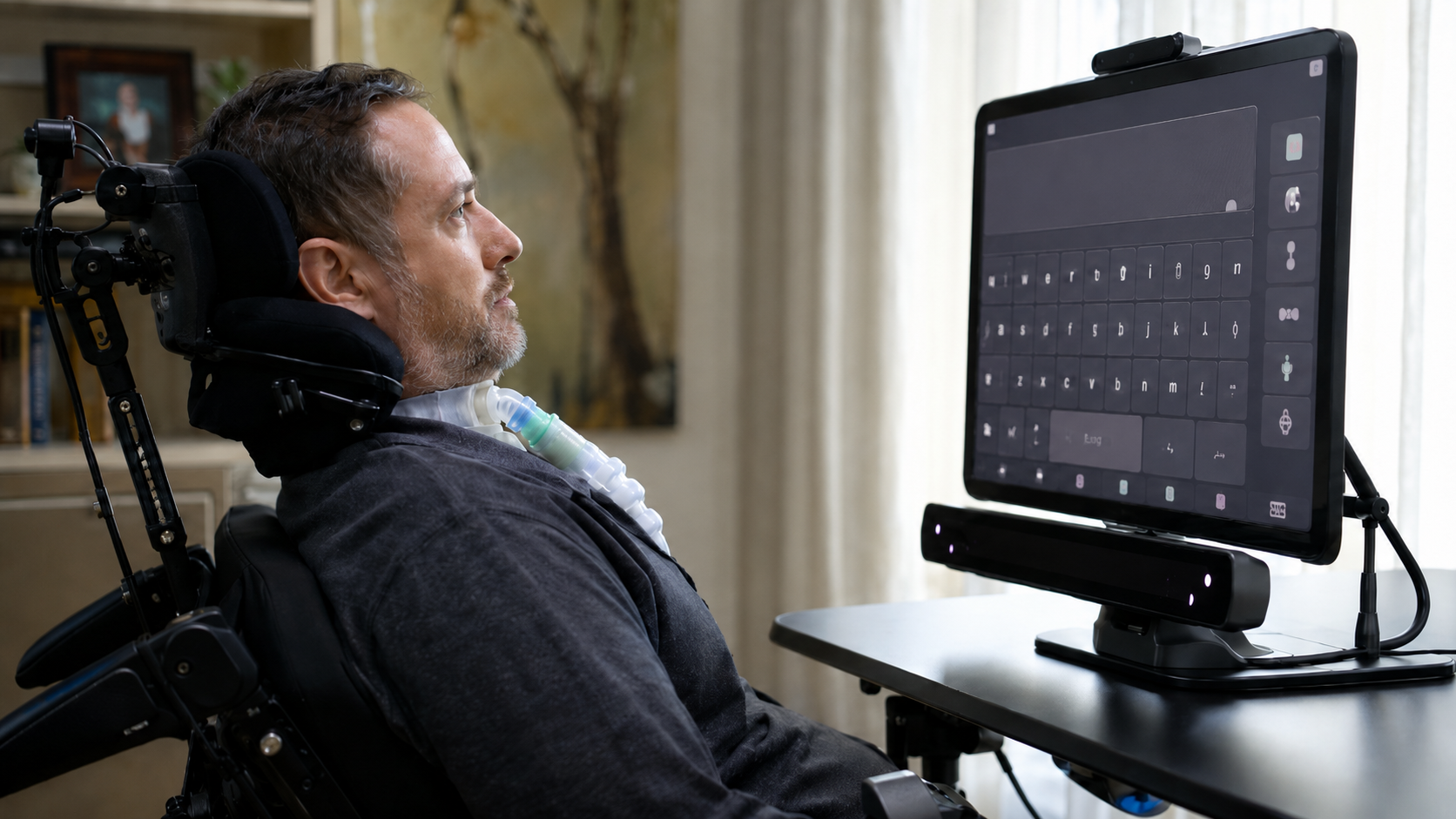
The underlying principle is more straightforward than it sounds. A small device, typically a bar mounted below a screen, shines harmless infrared light toward the user’s eyes. Cameras in the device capture the reflection of that light off the cornea, along with the position of the pupil, and software calculates precisely where on the screen the person is looking. The system builds a detailed three-dimensional model of the eye to do this accurately. Before first use, the person calibrates the tracker by following a few dots around the screen, which teaches the software how their particular eyes map to particular points. Once calibrated, the cursor simply goes wherever the eyes go, in real time.
Pointing with the eyes is only half the problem, though. If looking moves the cursor, how does a person click without a hand to press a button? The most common answer is an elegant technique called dwell. To make a selection, the user simply rests their gaze on a target for a set period, often around a second, and the system registers that sustained look as a click. Look at a letter, hold for a moment, and it is typed. This solves a subtle difficulty too, because gaze is naturally a little imprecise and jittery, and small targets near the edges of a screen are hard to fixate on. Dwell-based systems and clever interface designs are built to tolerate that imprecision, making selection comfortable rather than a strain. For those who retain a little movement elsewhere, an alternative exists: look at the target, then press a physical switch with a finger, foot, or even a puff of breath to confirm.
What this unlocks is not a gimmick but a genuine return of independence. Using only their eyes, a person can type out messages on an on-screen keyboard, and word-prediction software speeds this up by guessing the rest of a word after the first letters, sparing the user from spelling out every character. The typed words can then be spoken aloud by a synthesized voice, so a person who cannot move their lips can still hold a conversation in a room. The same gaze control extends across the whole machine: browsing the internet, sending email, using social media, scrolling a page by looking toward its edges, even dragging and dropping items on the desktop by looking from one spot to another. For someone who was effectively locked out of the digital world, the entire computer reopens.
The human impact of this is hard to overstate. Devices of this kind are designed specifically for people who can neither speak nor reliably use their hands, the population affected by conditions like ALS, cerebral palsy, muscular dystrophy, and spinal cord injuries. One longtime user of such a system described the change simply: being able to do all her emails, to write, to talk, she said her communication just opened up. The makers of these tools frame their mission in similar terms, as enabling people who would otherwise be locked inside their own bodies, unable to manage even the most basic communication, to live a far more functional and connected life. Restoring the ability to express a thought, to ask for something, to say “I love you,” is not a convenience. It is the restoration of a person’s presence in the world.
For a long time, the main drawback of all this was cost and specialization. Dedicated eye-controlled communication devices have historically been expensive medical equipment, and getting one often required clinical recommendation and significant expense. But that picture is changing in an encouraging direction. Eye-tracking has begun migrating into mainstream consumer technology, where the cameras and processing power needed to do it are now cheap and commonplace. Major operating systems and personal devices increasingly offer built-in eye-control features that work with standard hardware, meaning a tablet or phone someone already owns can become an accessibility tool without specialized purchase. The technology has also improved in practical ways that matter to real users, including trackers that work reliably outdoors in bright sunlight, not just in a controlled indoor room, freeing people from being tethered to a single environment.
None of this makes eye control effortless or perfect. It can be tiring to use for long stretches, calibration can drift, and gaze typing is slower than typing with ten fingers. Researchers continue to refine it, and on the horizon sit even more radical approaches, including brain-computer interfaces that aim to translate neural signals directly into text for people whose eye movement is also failing. For now, though, eye-tracking remains the most proven, practical, and widely usable bridge for people with severe paralysis.
What makes this technology so moving is its simplicity of purpose. It takes the one small motion a paralyzed person can still make, the flick of a gaze, and turns it into words, choices, and connection. It does not cure anything, and it does not pretend to. It simply refuses to accept that a working mind should be trapped behind a still body, and it hands that mind a way back out into the world, one glance at a time.